
Research
Mercury’s heart of Iron
Mercury’s core mass fraction (CMF) is ~0.7, more than double that of the other rocky planets in the solar system, which have CMFs of ~0.3. The origin of Mercury’s large, iron-rich core remains unknown.
Adding to this mystery, an elusive population of “Exo-Mercuries” with high densities is emerging. Therefore, understanding the formation of Mercury and its exoplanetary analogs is essential to developing a comprehensive planet formation theory.
Two hypotheses have been proposed to explain the high CMF of Mercury:
(1) earlier-stage iron enrichment of planetesimals closer to the Sun leads to the formation of an iron-rich planet.
(2) giant impacts during the latest stages of planet formation strip away mantle layers, leaving Mercury with a large core.
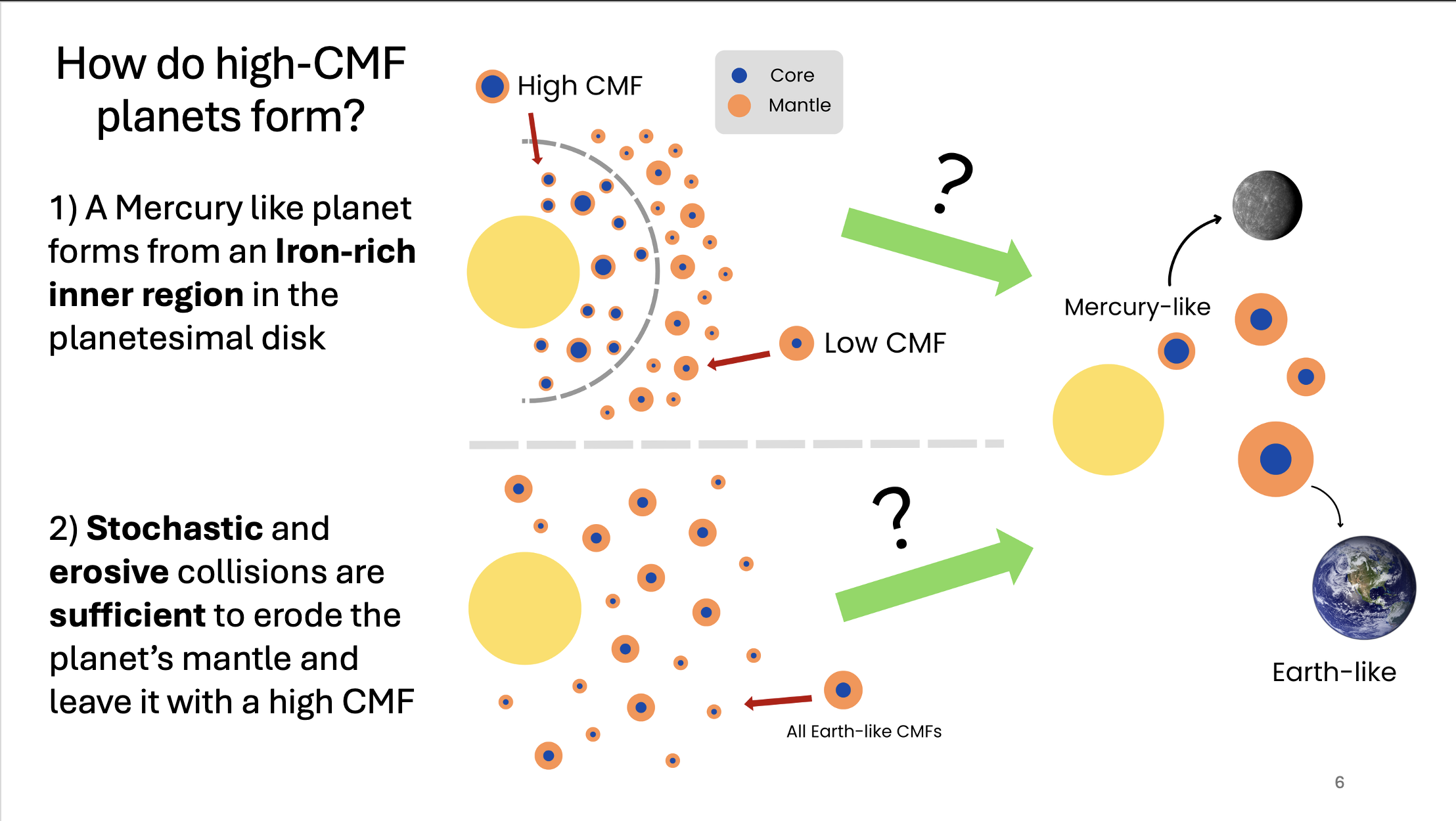
In this work, we conduct N-body simulations to test these two possibilities. Our simulations are focused on the solar system, however, we aim to provide a framework that can later be applied to the formation of high-CMF exoplanets.
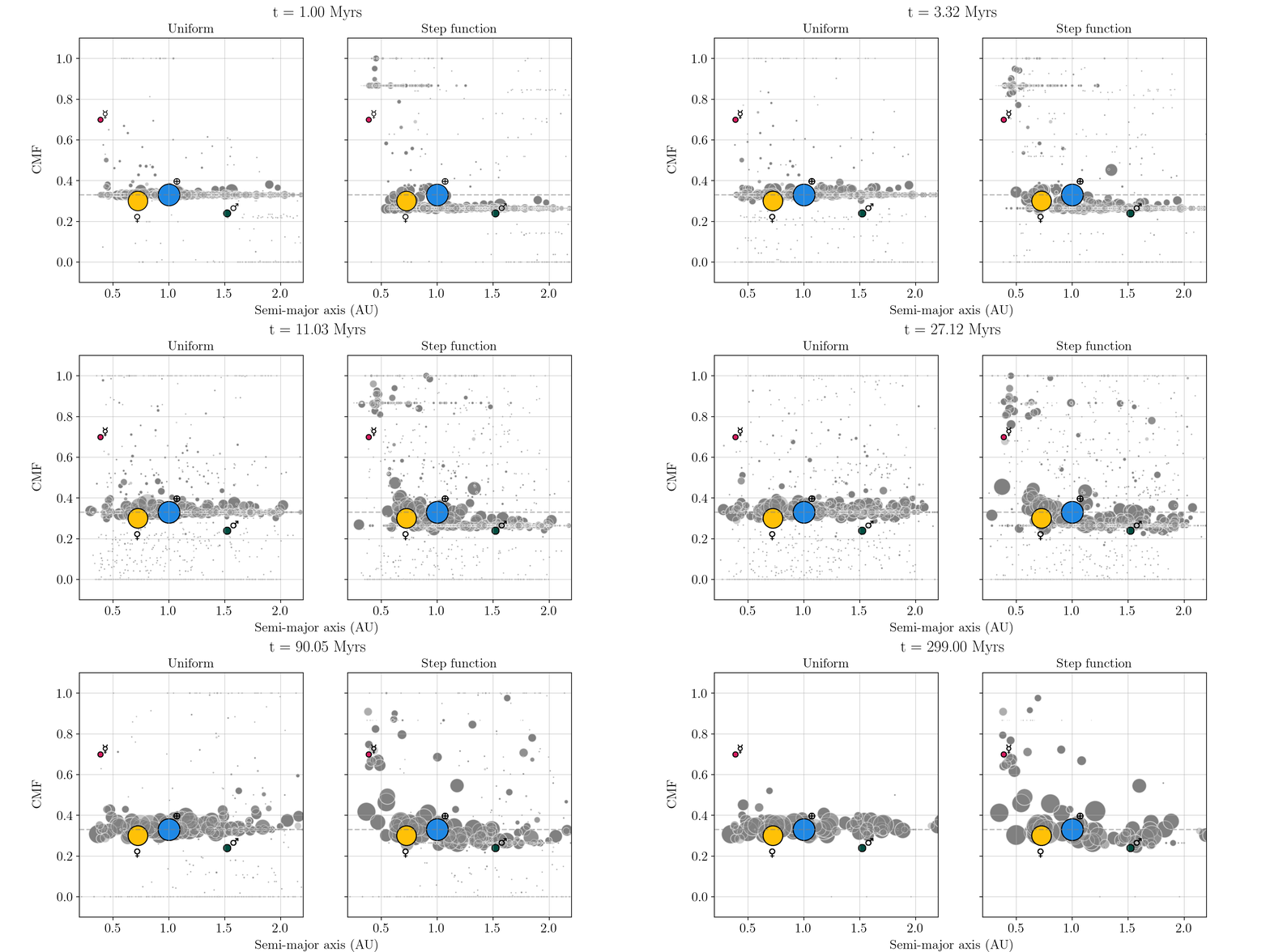
To investigate the giant impact scenario, we employ uniform initial CMF distributions. To address the other hypothesis, we use a step function with higher CMFs in the inner region.
For a uniform initial CMF distribution, our results indicate that although erosive impacts produce iron-rich particles, without mechanisms that deplete stripped mantle material, these particles merge with lower-CMF objects and do not lead to Mercury’s elevated CMF. However, a step function initial CMF distribution leads to the formation of a high-CMF planet alongside Earth-like planets, resembling the architecture of the terrestrial solar system.
If you are interested in this work, checkout my paper!
REBOUNDx Collision Module
REBOUNDx is an extension to the N-body code REBOUND. We are developing a comprehensive collision module within REBOUNDx, based on the collision prescriptions derived from hydrodynamic simulations (see Leinhardt and Stewart 2012). This module will allow users to track the composition of particles as they collide and evolve into planets. The outcome of a collision can vary based on the impact velocity, the mass of particles and the angle of the impact. This outcome might be merging, different types of erosion, or particles remaining intact.
This is an ongoing project, so keep an eye out for the paper, which is expected to come out soon!